

Call-center:


8 new self-service solutions transforming the market
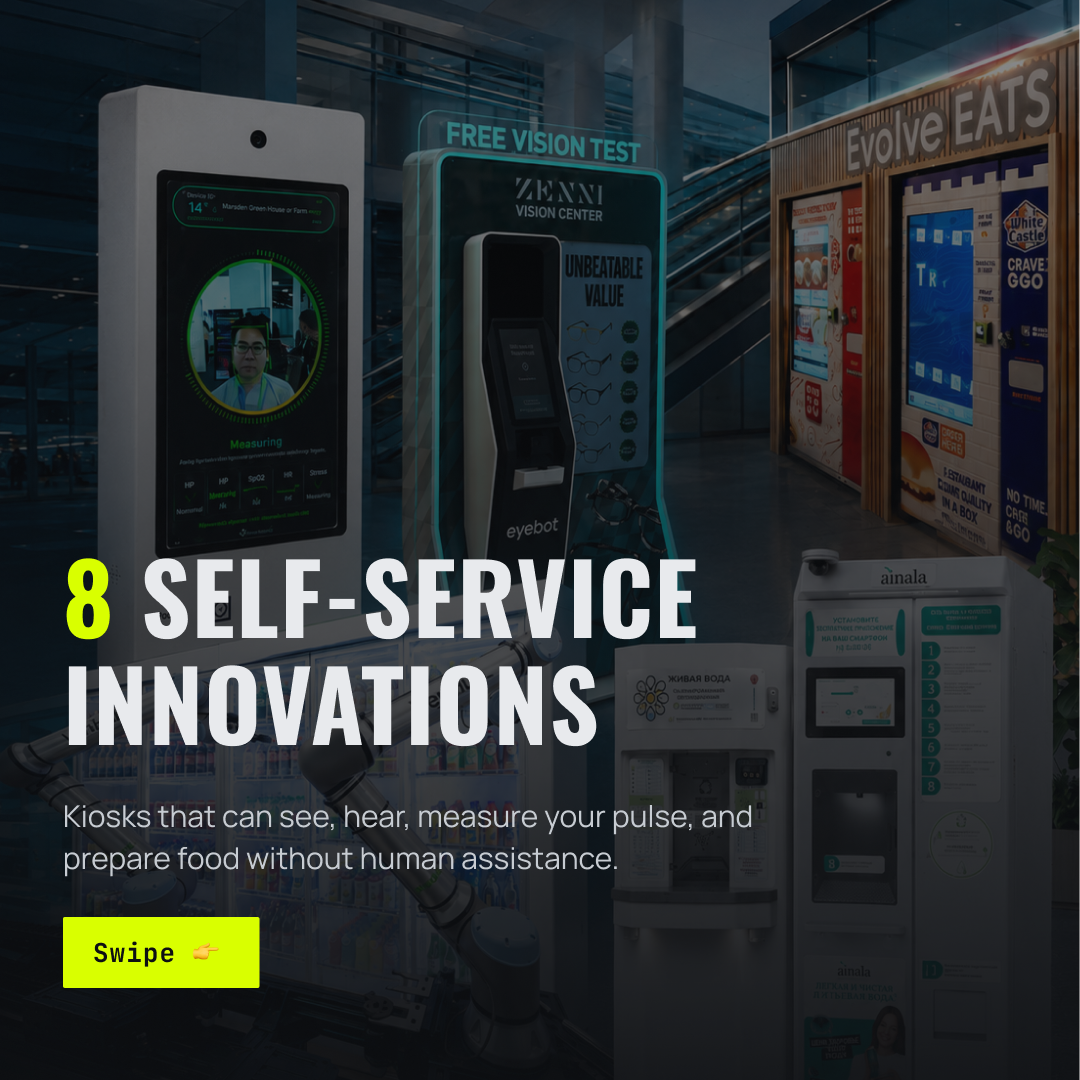
8 New Self-Service Solutions Transforming the Market
Self-service technologies are moving far beyond traditional payment terminals and checkout kiosks. Modern devices can recognise users, measure health indicators, recommend products, prepare food, and operate with minimal or no staff involvement.
In 2026, the self-service market is increasingly focused on artificial intelligence, robotics, accessibility, and personalised customer service. Here are eight emerging solutions that show what the future of self-service may look like.
1. AI Moves Inside the Kiosk
One of the biggest trends is the shift from cloud-based processing to on-device artificial intelligence. Instead of sending all information to an external server, an AI-powered kiosk can analyse images, recognise objects, and make decisions locally.
This approach helps businesses:
- reduce data-processing delays;
- improve device autonomy;
- decrease dependence on a stable internet connection;
- reduce cloud infrastructure costs;
- provide a higher level of data privacy.
Local AI is especially relevant for healthcare, banking, government, and retail self-service kiosks.
2. A Kiosk That Measures Your Pulse Through a Camera
Modern biometric technologies can assess a person’s condition without physical contact or wearable sensors. A camera detects subtle changes in skin colour and uses them to analyse key health indicators.
A healthcare self-service kiosk can measure:
- heart rate;
- breathing rate;
- blood oxygen levels;
- blood pressure;
- signs of stress.
These solutions can be installed in clinics, pharmacies, offices, airports, and public spaces. The user simply stands in front of the screen while the system performs the measurements automatically.
3. Automated Vision Testing and Eyewear Selection
Self-service kiosks in the optical industry allow users to complete a basic vision test without waiting for an in-person appointment. The device performs the test, generates the results, and can send a digital prescription to the user’s phone or email.
The customer can then continue to frame selection and order placement. This format combines several stages of service within one system:
- vision testing;
- prescription generation;
- eyewear selection;
- transfer of data to a partner or specialist.
Optical automation can make basic eye care more accessible, particularly in smaller communities and high-traffic locations.
4. Automated Household Chemical Refill Station
Self-service technologies are also expanding beyond finance and retail. Automated refill stations allow household cleaning products to be sold by weight or volume.
The customer brings a reusable container, selects the product and required amount, and the system automatically dispenses it.
Benefits of an automated refill station include:
- accurate dispensing;
- reduced use of disposable packaging;
- support for reusable containers;
- automated inventory and sales monitoring;
- indoor or outdoor installation;
- autonomous operation without permanent staff involvement.
This type of equipment is suitable for supermarkets, household goods stores, residential complexes, and sustainability-focused projects.
5. Accessibility as Part of Kiosk Design
New self-service kiosks are being designed for a wider range of users. Accessibility is no longer limited to software features—it also affects the physical structure of the device.
A kiosk may include:
- a Braille control panel;
- voice guidance;
- a screen reader;
- sign language support;
- an adjustable screen height;
- an adapted user interface.
Accessibility is becoming an important standard for equipment installed in banks, government institutions, hospitals, airports, and shopping centres. A self-service device should be usable by everyone, not only by the majority of customers.
6. Robotic Shops and Cafés
A robotic retail point is no longer just a vending machine. Modern systems can prepare drinks, assemble orders, dispense products, and accept payments without direct staff involvement.
New formats include:
- fully robotic stores;
- automated coffee stations;
- robotic beverage kiosks;
- autonomous food-preparation points.
These solutions allow businesses to operate around the clock, reduce repetitive manual tasks, and scale retail points without opening a full-size shop or café.
7. Autonomous Pharmacies and Kitchens
Self-service is also developing rapidly in food service and pharmacy operations. An automated kitchen can prepare and dispense a hot meal without staff, while a robotic pharmacy system can locate, check, label, and dispense the required medicine.
The main advantages include:
- 24/7 operation;
- reduced workload for employees;
- faster customer service;
- accurate product dispensing;
- lower risk of human error.
Fully autonomous points can be particularly useful in hospitals, business centres, universities, airports, and remote areas.
8. A “Restaurant in a Box” Across 1,000 Locations
Another promising format is a network of compact self-service restaurants. Through a single kiosk, the customer can choose a meal, place an order, pay, and receive the finished product.
These kiosks can be installed in high-traffic locations and scaled quickly. Instead of opening a traditional restaurant, a company can build a network of automated points connected through centralised software and remote management systems.
Such solutions are suitable for selling pizza, burgers, baked goods, beverages, and other ready-to-eat products.
How the Self-Service Market Is Evolving
These new technologies show that a kiosk is no longer simply a screen used for payments. It is becoming an intelligent and autonomous system capable of seeing, listening, analysing data, and performing physical tasks.
The main self-service technology trends include:
- artificial intelligence integration;
- local data processing;
- robotic retail operations;
- autonomous 24/7 service;
- personalised customer experiences;
- accessible interfaces;
- multiple services integrated into one device.
For businesses, this means lower operating costs, faster customer service, and the ability to launch new sales formats without significantly increasing staff numbers.
The Future of Self-Service Kiosks
In the coming years, self-service kiosks will increasingly combine software, computer vision, biometrics, robotics, and remote monitoring systems.
A device will be able to recognise a user’s request, recommend the appropriate service, complete the required operation, and transfer the data to a central information system.
Self-service is becoming a major tool for business digital transformation. Companies that adopt modern self-service solutions today can scale faster, improve the customer experience, and develop new service models.